
Circuit. Last week, I had the opportunity to give the keynote speech at our local Friends conference in Philadelphia. Friends is the National Association of Young People Who Stutter, and I gave an update on the science of stuttering, including our genetic studies. However, rather than starting with the zebra finches or images of the unusual representation of speech in my own brain, I started my talk by showing the book cover of The User Illusion. This book made me interested in neuroscience in the first place, and I thought that the underlying theme is a great introduction to the mysteries of human fluency. Here are my thoughts.
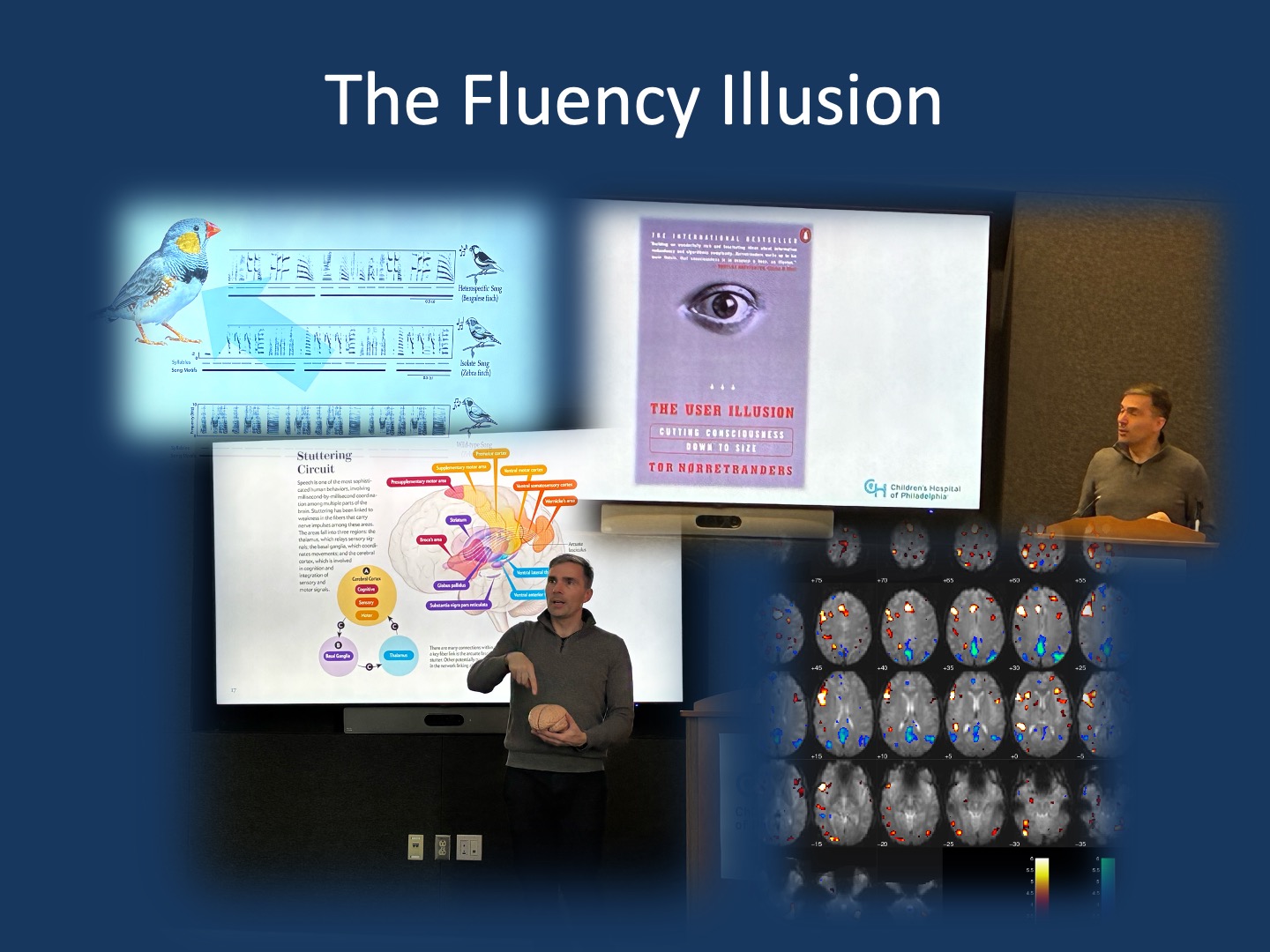
Figure. The Fluency Illusion across systems and scales. This composite figure illustrates how seemingly simple fluent speech emerges from multiple layers of biological organization. Top left, zebra finches, a key model system for vocal learning, show natural interruptions and blocks in their song, highlighting that even well-conserved vocal behaviors can be inherently variable. Top right, I introduce the concept of the “user illusion” from The User Illusion, which inspired the idea of the fluency illusion as presented in this blog post, framing fluent speech as a process that appears simple but reflects hidden complexity. Bottom left, I explain the stuttering and fluency circuit using a brain model, emphasizing the distributed network of cortical and subcortical regions required for timing, initiation, and coordination of speech. Bottom right, functional imaging from my own brain demonstrates bilateral language representation with relatively greater right-sided involvement, one example of the many variations in language organization observed in people who stutter. Together, these panels illustrate that fluency is not a single function but an emergent property of interacting systems that remain largely invisible until disrupted.
Lost in translation. When I showed Nørretranders’ book cover on the big screen, I realized how unsettling it actually looked, a single eye staring at the audience. However, my excuse was that this was not the book cover that I was used to when it was given to me as a high school graduation gift. The German version was published a few years before it was translated into English and, in addition to a less dramatic book cover, the title was different (“Sense the World”). Because of the different title, the user illusion component of the book escaped my memory for several decades until I stumbled upon it again last year when I read I’ve Been Thinking by Daniel Dennett, who passed away in 2024.
Under the hood. So what is the infamous user illusion? In brief, it describes how the conscious self feels like a central controller but is actually a simplified narrative produced by distributed, unconscious brain processes. It is like driving a car without opening the hood: you experience smooth control while complex machinery operates underneath. The most famous example that I remember from my 1996 read of Nørretranders’ book is the experiment by Benjamin Libet, who showed that the brain’s readiness potential precedes the conscious intention to act by several hundred milliseconds, suggesting that what we experience as a voluntary decision may be an awareness after the fact of processes already underway. Or, as I remember it slightly incorrectly from reading it almost 30 years ago, human consciousness is half a second behind.
Fluency. So how do we get from the mystery of human consciousness to human fluency? In brief, it is a similar illusion. For the non-stuttering population, fluency is something that is taken for granted, a concept that often does not even have a name because it is so automatic. You think something and then you say it. Words appear in your mind and then you speak them, fluently. What stuttering shows is that this process is not as simple as it seems, that there is much more “under the hood” than it appears at first. When something that you take for granted is disrupted, it initially has a strange appearance. This is why stuttering feels so unusual for non-stuttering people: it challenges an underlying assumption that is never really articulated, that there is nothing complicated about generating words in your mind and then speaking them. However, as with the user illusion and human consciousness, things are not as they seem. There is an entire network in the brain involved in keeping speech fluent.
The Fluency Circuit. The best example that there is more than meets the eye with fluency and stuttering is the phenomenon that people who stutter become strikingly fluent when they sing. This suggests that fluent speech depends on a well-timed brain network involving the basal ganglia, supplementary motor area (SMA), Broca’s area, primary motor cortex, auditory cortex, and cerebellum. When singing, rhythm and melody act like a metronome, helping the brain start and connect words smoothly. This reduces the need to constantly monitor and correct speech, making it flow more easily. Fluency is therefore a timing problem before it is a language problem. In this way, fluency is less about effort and more about timing working just right. And it provides a good example of why “looking under the hood” of stuttering is valuable: it takes apart fluency as a phenomenon taken for granted and points out the various components and factors that affect it, including explanations for some initially counterintuitive findings.
What you need to know. This blog post is not meant to explain stuttering or suggest how to work with it. Rather, what I wanted to achieve was to suggest a different way of thinking about it, using stuttering as a way to better understand how fluency, which is usually taken for granted, actually represents a complex phenomenon in the brain involving a surprisingly large number of structures. Things are not how they initially seem when it comes to fluency, and this may give us a moment to pause and shift our perspective.
