
MDBR 2025. Imagine a sugar cube-sized piece of our brain. Within this small segment of neuronal tissue, the total length of nerve fibers amounts to approximately 70 miles. This is exactly the distance I rode for the 2025 Million Dollar Bike Ride last Saturday as a member of Lulu’s Crew. Here is my blog post on a different kind of fundraising for rare disease research, the type of advocacy that has raised more than a million dollars for STXBP1 in the last seven years while making your legs feel like Jello.
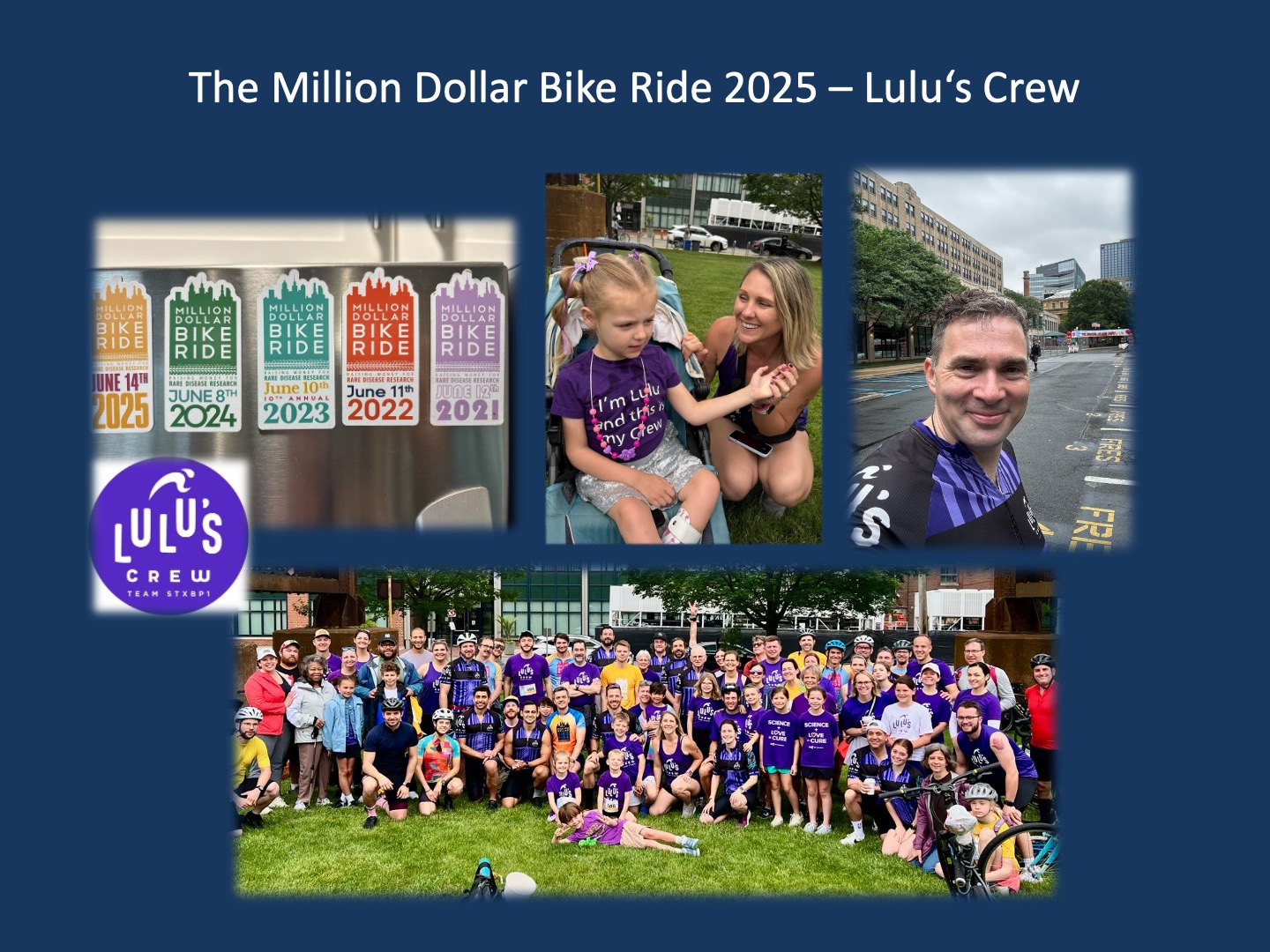
Figure 1. Some impressions from the Million Dollar Bike Ride 2025. The fridge magnets of the various MDBRs that have raised more than $1M for STXBP1 research over the last few years. Lucy and Erin at the Bike Ride on June 14th. Me, just having finished the 70 miles. Group photo of Lulu’s Crew at this year’s Million Dollar Bike Ride in Philadelphia.
Orphan disease. The Million Dollar Bike Ride (MDBR) is a classic. It is a fundraising event that has been organized by the University of Pennsylvania Orphan Disease Center for the last eleven years. The goal of the bike ride is to raise funds for rare disease research, and approximately 750 riders per year join this event. At our last ride in 2024, 38 teams raised a total of $2.6 million for 31 rare diseases. This year, Lulu’s Crew, the team supporting STXBP1 research, passed an important milestone. Over the last seven years, we have raised more than $1M for STXBP1 alone. These funds, raised through cyclists in their saddles, has been translated into more than a dozen research grants that have helped advance our understanding of STXBP1.
Lulu’s Crew. I consider myself an MDBR convert and novice. While Lulu’s Crew has been riding for the last seven years, I have only joined the last four bike rides. Lulu’s Crew is organized by Erin Prosser and her husband Ben, whose daughter Lucy (Lulu) has an STXBP1-related disorder. Erin has been relentless, organizing one of the largest MDBR teams for the last few years. Members of Lulu’s crew typically participate in the full range of distances that the MDBR offers: from the one-mile walk or 10-mile bike ride along the Schuylkill River to the more demanding 32-mile, 50-mile, and 70-mile rides. After doing my first bike in 2022, I bought a road bike, started practicing, and somehow got tricked into riding the full 70 miles last year for the first time. And this year, it appears that I tricked myself.
Thoughts during the ride. Did I selflessly think about raising funds for a rare synapse disorder on the brink of clinical trials during my five and half hours on the road? Did I think about being a representative of our ENDD Center spreading rare disease advocacy while fighting the rain in Montgomery County? Not really. My goal was to keep going and fight my inner demons. Realizing that I was unable to keep a heart rate in the 170s while trying to draft behind the faster riders, cursing underneath my breath when I passed the point of no return, and attempting to get some comfort beyond mile 45 while I was starting to get sore in the saddle, I thought about naming the various points on the road. Desperation Peak. False Hope Mountain. Meditation Hill (a steep climb in Evansburg State Park where I slowed down so dramatically that I decided to observe my breath rather than getting frustrated about not moving forward at all). You can tell from all of this that I’m not an athletic person. But somehow, I made to through the full 70 miles.
Encounters on the road. During the MDBR, you learn something from your encounters during the ride. With more than 30 teams riding, you’re not necessarily familiar with all other teams and the conditions they ride for. However, you can often distinguish them from their cycling jerseys. Here is how one of these discussions played out at traffic stop: “What team are you riding for?” – “LAM Foundation – Easy Breathers” (…and the cyclist took off and I couldn’t keep up). I ended up reading up on LAM after the bike ride. LAM stands for lymphangioleiomyomatosis, a rare, progressive lung disease mainly affecting women. LAM involves the abnormal growth of smooth muscle-like cells that obstruct airways and blood vessels, which leads to shortness of breath and chest pain. LAM is linked to mutations in the TSC1 or TSC2 genes and is much closer to our genetic epilepsies than you would think, where mTORopathies are critically important. Advocacy in action—and it clearly worked on me.
The fundraising narrative. Rather than boring you with my cycling (mis)adventures, I wanted to point out the magic of the MDBR. In brief, it changes the narrative of rare disease and fundraising to support the various research efforts and find novel therapies. Cruising through the countryside with the crystal structure of STXBP1 on my cycling jersey is an honor and privilege. However, this is not the true magic of the Million Dollar Bike Ride. The true story is that the MDBR makes fundraising for rare disease look …cool. And if we can demonstrate that rare disease research is not only important and meaningful, but also entertaining and fun, then nothing can stop us, and support for rare diseases can become self-perpetuating. As a personal goal, I’d like to improve by next year to keep up with the other riders—and maybe I’ll manage to spread some STX awareness along the way.
