
Language. There are a few words in medicine that seem simple until you say them out loud in front of the wrong audience. In rare disease clinics, two of them are cure and treat. We use them constantly, sometimes interchangeably, and rarely stop to ask what they do to hope, to expectations, and to the quiet contract between clinicians and families. In rare disease, language is not a neutral medium. It is an intervention.
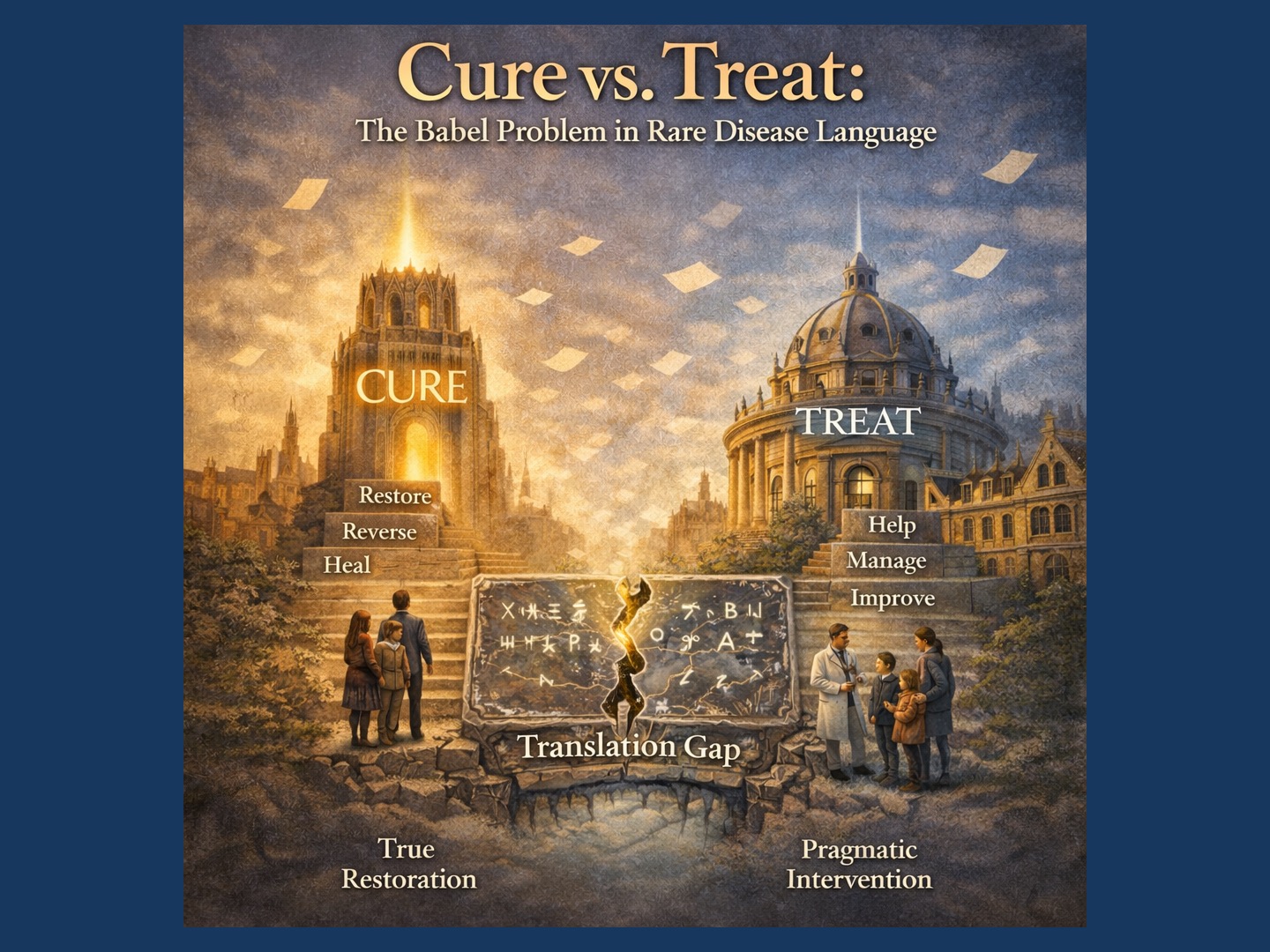
Figure 1. Conceptual illustration of cure versus treat as a Babel-like translation problem in rare disease. Echoing the visual language of RF Kuang’s Babel cover, twin Oxford-like towers face each other across a fractured silver-working tablet, the Translation Gap. Floating pages and cryptic glyphs evoke untranslatable meaning, where promise, hope, and trust accumulate. In rare disease, these gaps shape expectations, advocacy narratives, and the clinician–family contract.
Silver-working. RF Kuang’s Babel is a historical fantasy novel set in an alternative 19th century Oxford, centered on a translation institute that trains students from across the British Empire. In Kuang’s world, translation is not merely academic—it powers empire. The scholars at Babel practice silver-working, a form of linguistic magic that draws power from what cannot be perfectly translated between languages. The core idea is unsettling and brilliant: the small gaps between words are not just misunderstandings. They are energy. And whoever controls translation controls the world.
Meaning between words. I am not a native speaker. Like many people who live their professional lives in a second language, I am acutely aware of the space between meanings, the tiny misalignments between English words and the concepts they map onto in my native German. Those gaps sometimes create confusion. But they also make you notice something important: words have a penumbra of meaning, a halo of implied promises that native speakers often glide past without seeing. In rare disease, we live inside a smaller, less obvious Babel. We translate between mechanism and lived experience, between papers and parents, between what a therapy changes in a model and what it changes in a life. And nowhere does this matter more than in the difference between cure and treat.
Two English words, two promises. In English, treat is a workhorse word. It implies action and support: we can do something meaningful even if the diagnosis remains. It can include seizure reduction, improved sleep, fewer hospitalizations, better communication, functional gains, school support, anything that makes life more stable and more possible. When we say “we can treat this,” families often hear: “we can help.”
Cure is different. Cure is a hard-edged word. It implies reversal, restoration, a before and after. In epilepsy and neurodevelopmental disorders (NDD), cure rarely means seizures alone. Families often carry a deeper hope: not only seizure freedom, but also a life with fewer limitations, less cognitive impairment, fewer developmental delays, fewer behavioral crises, less dependence, more autonomy. Cure is not merely an endpoint. It is a gravitational field that pulls conversations, fundraising strategies, and research narratives into a single arc: “bring my child back”. No one uses cure irresponsibly on purpose. Families use cure because the alternative feels like surrender. Researchers use cure because it motivates. Advocates use cure because it rallies. But cure is a banner word: powerful, useful, and inherently dangerous.
Strict languages. German is stricter, and that matters. This is where translation becomes more than a metaphor. If you carry these words over into German, you notice that English is unusually permissive. In German, “to cure” in the strong sense is closer to Heilung or heilen, words that feel weighty, almost final. Heilung suggests genuine restoration. It is not casually promised. Treated, on the other hand, fits comfortably with behandeln or Therapie. Behandlung is pragmatic and procedural. It lives in the real world of hospitals and chronic conditions. It does not pretend the disease stops existing.
Semantic shortcuts. English, by comparison, allows a kind of semantic shortcut. We can say “curative therapy” and mean “disease-modifying.” We can say “this could be a cure” and mean “this could be transformative.” German resists that. It forces more precision, or at least more humility. And in rare disease, precision is not pedantry. The space between cure and treat is often where trust lives. When language is too flexible, promises leak into places they do not belong.
The untranslatable thing is hope. In “Babel”, power comes from what cannot be perfectly translated. Rare disease language works similarly. Cure and treat do not translate cleanly not only between English and German, but between worlds: scientist to parent, clinician to advocate, biotech to community. What fails to translate is not the definition, it is the emotional payload.
Cure as used by families. When a family says “we want a cure,” they may mean: stop the seizures. But they may also mean: give my child a future with less disability, less dependence, less suffering, and give our family a life that is not structured around crisis management.
Cure as used by scientists. When a scientist says “this might be curative,” they may mean: we fixed the mechanism in a model, shifted a biomarker, improved developmental milestones in mice. The mismatch is rarely malicious. It is structural. It lives in the gap.
A clinician’s translation rule. Let me try to be explicit about a small framework. This is not about dampening hope. It is about protecting it, making it durable, so progress does not later feel like betrayal.
Treat = we can help meaningfully, even if the condition remains.
Disease-modifying = we can change the trajectory.
Remission = symptoms can disappear for prolonged periods.
Cure = the condition no longer produces disease across time.
Care. There is another German word that belongs in this discussion: Versorgung. It is more than care. It means provision, support, the infrastructure of being carried through a chronic condition. Rare disease families rarely ask only for a cure. They also ask for Versorgung: expertise, therapies, equipment, school services, respite, and a system that treats their child as fully real while science catches up. And perhaps that is the deeper point. When we argue about cure vs treat, we risk missing what families are actually saying. Cure is an aspiration. Treat is an action. Versorgung is the lived middle ground.
What you need to know. In rare disease, cure and treat are promise-shaped words. English lets them blur; German draws a sharper line by reserving Heilung for something closer to true restoration and using Behandlung for pragmatic intervention. RF Kuang’s Babel reminds us that translation is power, and in rare disease the translation gap between cure and treat is where expectations and trust are built or broken. If we want families to stay with us through decades of incremental progress, we need to use language with the same care and precision that we demand from our science.
