
Improbable. A global metropolis rising from open desert simply should not exist. It should not work climatically, economically, or historically. And yet Dubai did it. At this year’s World Health Expo WHX in Dubai, one of the largest global healthcare gatherings with more than 60,000 participants, visitors entering the South Hall were greeted by a large-scale animation of synaptic vesicle fusion, the SNARE complex zippering into place guided by MUNC-18 (STXBP1). We developed this display to visualize mechanisms in genetic neurodevelopmental disorders. Watching this animation, I thought about improbability and about what makes complex systems succeed.
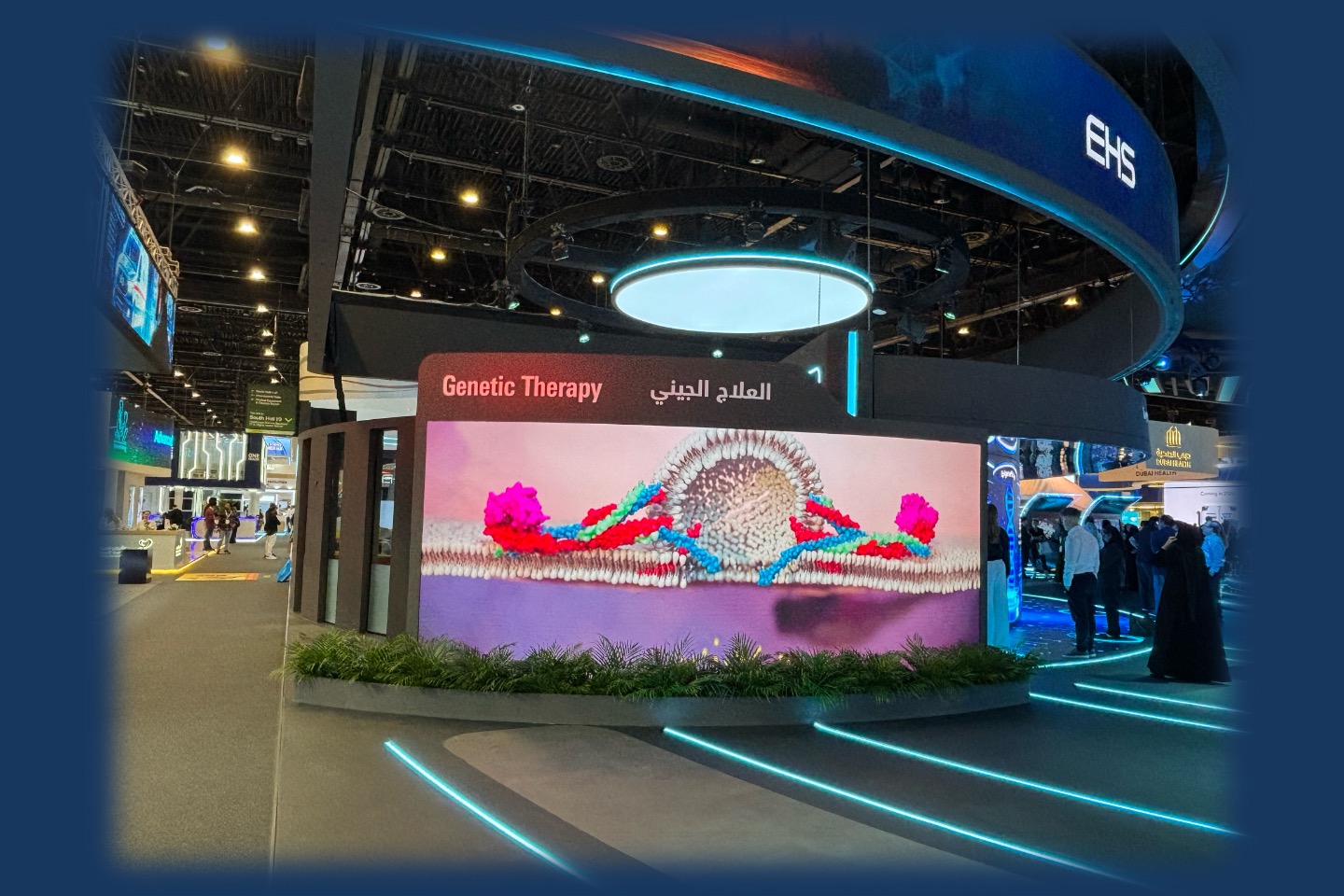
Figure 1. Minimal fusion at scale. Our animation of synaptic vesicle fusion displayed at the Emirati Health Services booth at World Health Expo WHX 2026 in Dubai. The installation visualized SNARE complex assembly guided by MUNC-18 (STXBP1), attempting to illustrate disease mechanisms in synaptic disorders. It was projected prominently in the South Hall and formed part of the broader exhibition space.
WHX 2026. We were invited by Emirati Health Services (EHS) to present our work on rare genetic epilepsies and neurodevelopmental disorders at a meeting that typically focuses on medical technology, device innovation, pharmaceutical partnerships, hospital systems, and digital transformation. Rare disease biology is not usually central at gatherings of this magnitude. And yet we were fortunate that our synapse animation was prominently displayed at the EHS booth and frequently photographed or videotaped by participants. The days moved quickly and on the flight home, I thought about the parallels between building a city like Dubai and working toward epilepsy precision medicine.
The improbable city. Dubai’s trajectory is often attributed to capital. But capital alone does not produce cities that are durable and stable. Infrastructure requires governance, long term planning, and alignment across sectors. The contrast with a place called Fordlândia is instructive. Fordlândia was Henry Ford’s attempt in 1928 to build a rubber plantation and model American town in the Brazilian Amazon to secure rubber supply for his factories. The project was heavily financed and meticulously planned according to Ford’s vision. It had housing, hospitals, and schools. However, it lacked ecological insight and integration into the local reality. Disease, labor unrest, and agricultural failure undermined the effort. The project collapsed despite substantial investment.
The tower that nearly wasn’t. Dubai’s most visible symbol, the Burj Khalifa, almost did not get finished. At 2,717 feet or 828 meters, the Burj is the tallest building in the world. During the 2008 to 2010 financial crisis, Dubai’s real estate market contracted sharply and construction stalled. Stabilization required significant financial support from Abu Dhabi. The completion of the Burj was not simply about ambition. It required institutional backing and economic integration. Large scale projects like the Burj often test whether a given system can absorb shock.
Rare epilepsies. Rare genetic epilepsies are now entering a comparable phase of scale. In 2025, more than half a billion dollars in venture and strategic capital flowed into programs targeting defined genetic epilepsy syndromes. The rare epilepsy segment is estimated at approximately $2.25 billion this year, with projections approaching $3.1 billion by 2029. Within a broader $15 billion epilepsy market, these conditions represent a small but strategically important segment.
Structure. However, the rise of epilepsy genetics was not automatic. Early gene discoveries required coordinated efforts, shared data, and long-term collaboration between groups. Many approaches failed. Progress depended on building durable clinical and research infrastructure, including natural history studies (NHS), alignment with advocacy groups, and regulatory frameworks that industry could rely on across funding cycles. Investment followed structure, not the other way around. Only once these elements were in place did industry engagement accelerate.
Parallels. The lesson is straightforward. Complex systems fail when planning is disconnected from local biology and lived reality. They succeed when capital is paired with integration, coordination, and long-term commitment. Rare disease precision medicine is now operating at a new scale. Whether it remains durable will depend less on the next funding round and more on the strength of the clinical and scientific infrastructure that supports it. In that sense, we should aim to build like Dubai and avoid becoming Fordlândia.
