
ZARD. Last year I became acquainted with a neurodevelopmental disorder that I knew relatively little about before, ZC4H2-Associated Rare Disorder, or ZARD. First of all, this was a good reality check for me that the field of genetic neurodevelopmental disorders is broad and includes many conditions where more than a hundred individuals have been reported in the literature and twice as many families are represented by advocacy organizations. And yet, these some of these conditions remain rare enough that our program largely misses them, even after having evaluated more than 7,000 individuals with epilepsy and neurodevelopmental disorders. However, this gap in knowledge gave me the opportunity to rapidly acquaint myself with a condition based on available information. And this is when I stumbled upon an unusual feature of ZC4H2-related disorders that made me pause: the surprisingly high frequency of congenital contractures for a neurodevelopmental disorder. Here is what I learned.
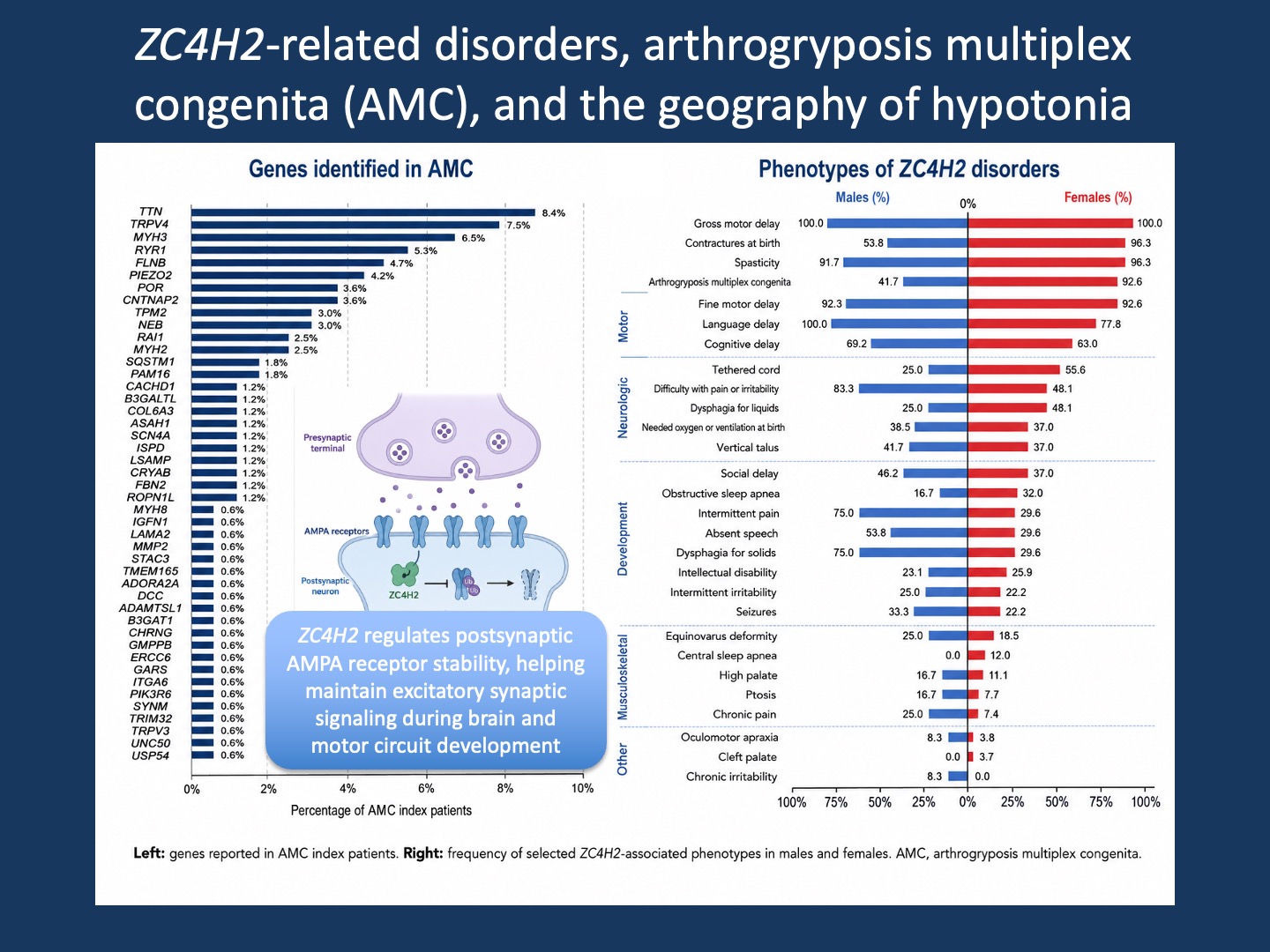
Figure. ZC4H2– related disorders, AMC, and hypotonia. The left panel summarizes genes identified in individuals with arthrogryposis multiplex congenita, highlighting that most recurrent genetic causes of AMC localize to muscle, the neuromuscular junction, peripheral nerve, or spinal cord rather than primarily to the brain. Data are adapted from Laquerriere et al., 2022, Clinical Genetics. The right panel shows the frequency of selected clinical features in males and females with ZC4H2 -related disorders, demonstrating the broad neurodevelopmental, motor, neurologic, and musculoskeletal spectrum of ZARD, including the high frequency of congenital contractures and AMC. Data are adapted from Peters et al., 2024, Pediatric Neurology. The inset provides a simplified conceptual model of ZC4H2 function at the postsynaptic membrane, where ZC4H2 regulates AMPA receptor stability and excitatory synaptic signaling during brain and motor circuit development, adapted from Wan et al., 2025, PNAS.
Hypotonia. ZC4H2-related disorders were first identified in 2019, and early cohorts showed congenital contractures in more than 70% of individuals. In a recent study by Peters and collaborators, a broader summary of the literature and newly reported individuals included 105 affected individuals across 42 families, and arthrogryposis multiplex congenita was reported in 93% of females versus 42% of males. This frequency is much higher than what we usually see in most genetic neurodevelopmental disorders (NDD) and suggests a neuromuscular involvement that very few genetic neurodevelopmental disorders have. In order to explain why I was surprised by this, I need to be slightly academic at first. Please bear with me, it will make sense in the end. First, let me explain the two types of hypotonia that we see in child neurology and why I consider them conceptually different.
Central versus peripheral. In neurology, we typically make a clear distinction between central and peripheral hypotonia. Central hypotonia refers to low muscle tone due to dysfunction of the central nervous system, while peripheral hypotonia is due to disorders of the motor unit, including the peripheral nerves, neuromuscular junction (NMJ), or muscle. This distinction matters because it points to the anatomic site of the problem and the underlying mechanism. Central hypotonia points toward brain involvement, often with relatively preserved strength and reflexes, while peripheral hypotonia suggests motor unit disease and is more likely to come with true weakness, reduced reflexes, and a neuromuscular workup. Given that central hypotonia locates to the CNS, it is the hypotonia that is typically associated with other neurodevelopmental features such as autism, developmental delay, or epilepsy. While these features can also be present in an individual with peripheral hypotonia, dysfunction of a peripheral nerve or motor unit would not account for them alone.
AMC. In the literature on ZC4H2-related disorders, one particular clinical feature stands out: arthrogryposis multiplex congenita, or AMC, the medical term for multiple joint contractures present at birth. AMC usually reflects reduced fetal movement or impaired motor activity that is already present in utero. A 2022 study by Laquerriere and collaborators examined 315 unrelated AMC families and identified a genetic cause in 166 individuals, or 53%. Of the identified genes, 80% were either myopathies, including TTN, NEB, and RYR1, disorders of the neuromuscular junction, including MUSK and RAPSN, or spinal cord disorders, including ECEL1, SNM1, and TRPV4. Only a small percentage of causative genes were linked to a primary role in the brain, or affecting the upper motor neuron, to use precise neurological terminology. Even though AMC is also seen in CACNA1E-related disorders and a recent study by Gverdtsiteli and collaborators suggests AMC as a shared phenotype across brain expressed sodium channelopathies, this presentation is rare for conditions without direct impact on the motor unit.
Biology. ZC4H2 is thought to be important for early neurodevelopment, helping shape neuronal differentiation and nervous system development. It also acts at postsynaptic sites to regulate AMPA receptor stability and excitatory synaptic signaling. However, AMPA receptors, encoded by the GRIA genes, are not used at neuromuscular junctions. Therefore, the biology of ZC4H2 has much more in common with postsynaptic neurodevelopmental disorders, including GRIA-related disorders, GRIN-related disorders, SYNGAP1, and DLG4, than with the typical myopathies or neuromuscular junction disorders that are associated with AMC. With a high frequency of seizures, cognitive delay, and speech delay, ZC4H2-related disorders share common features with these conditions. However, the high frequency of AMC stands out.
What you need to know. Given the large number of rare disorders, there is an increasing push toward cross-disease analysis when it comes to trial readiness. In brief, when we think about hypotonia in neurodevelopmental disorders, there is often an assumption that the overall trajectory may be related if hypotonia can be located to the CNS. However, if a condition shows features of both central and peripheral hypotonia, this analogy breaks down conceptually and the trajectory may be different. Recognizing conditions with mixed central and peripheral hypotonia offers a unique possibility of meaningfully stratifying the broader group of genetic conditions that present with hypotonia. This may make these conditions more predictable for counseling and clinical care, while also helping define outcome measures for future trials.
